

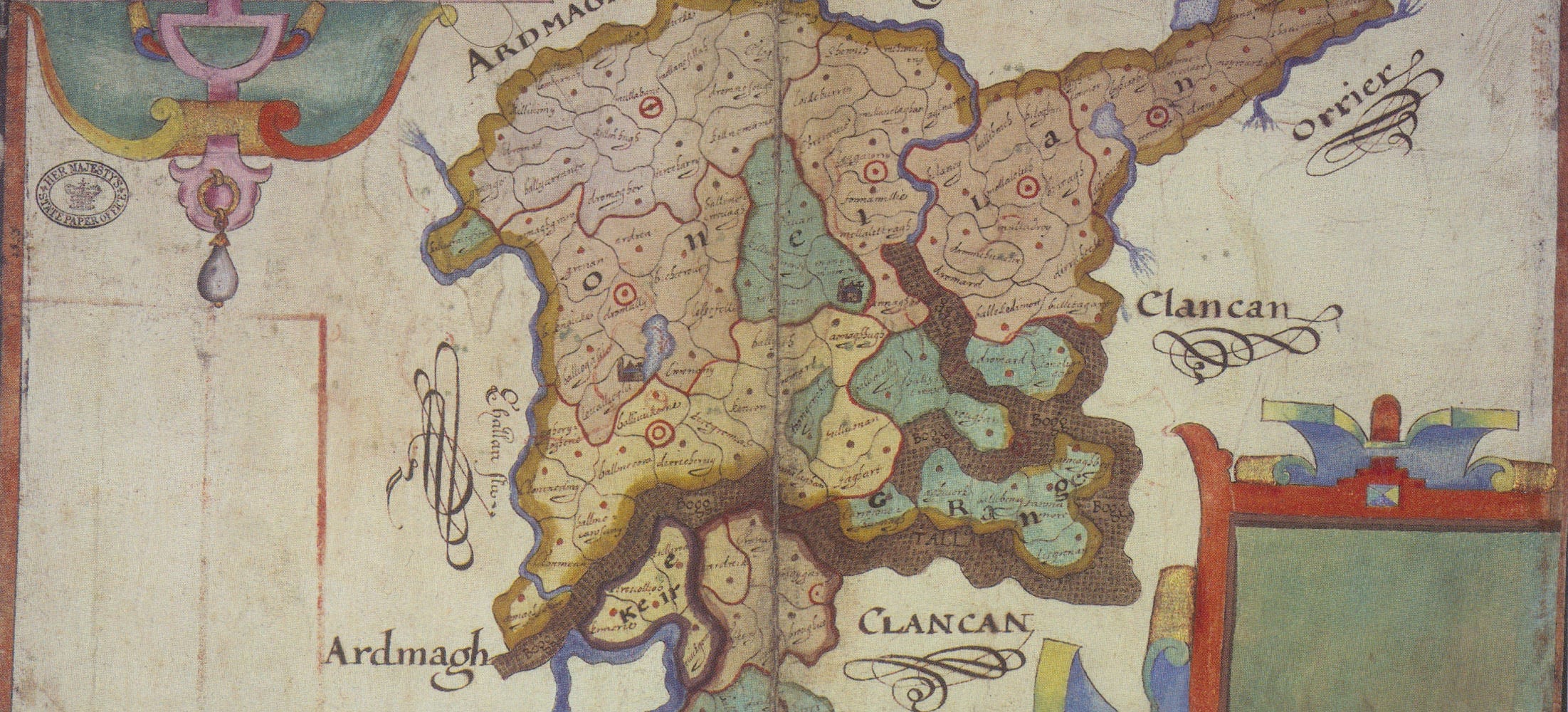
Townlands are the smallest official land divisions in Ireland. They were established by the 12th century and many likely have earlier tribal territory origins. While they cover the entire island of Ireland, including islands, they aren’t an official land boundary in Northern Ireland. However, they are still used colloquially there.
The vast majority of townland names were composed, or evolved in the Irish language. Over time, they were mostly translated - often meaninglessly - to English. This process began in the 12th century with the Anglo-Normans, and was largely completed by the systematic approach of Britain’s Ordnance Survey in the early 19th century.
Because of the great phonemic and orthographical differences between Irish and English, anglicisation had the effect of shrouding place names of Irish origin in an impenetrable fog of unintelligibility.
From a paper titled Ireland’s heritage of geographical names by Dónall Mac Giolla Easpaig.
Thanks to the work of the Placenames Commission, establised by the Irish state in 1946, which became the Place Names Branch, we now have access to high quality Irish forms of place names, including townlands. Websites like logainm.ie and townlands.ie are excellent resources for exploring and researching Irish place names.
Townland names are generally composed of simple but descriptive assemblies of between one and three words. Some describe human settlements, e.g. Raheenglass - An Ráithín Glas, which translates to little green rath or ringfort.
Ringforts or ring forts are small circular fortified settlements built during the Bronze Age, Iron Age and early Middle Ages up to about the year 1000 AD. They are found in Northern Europe, especially in Ireland.
Wikipedia article on ringforts
Others give a sense of what the landscape was like, or is still like e.g. Coolderry - Cúil Doire, meaning nook or corner of the oaks. There are also no shortage of colourful ones like Ballyhuppahane or Baile Shopacháin, meaning home or town of the wispy man.
In the Republic of Ireland, their relevance and significance varies depending on where you grew up and now live. In urban areas, people are less likely to know what their townland is or, in inner city centres, they may not even have one.
Having grown up in the countryside in Co. Laois, I knew and still remember the townlands I lived in - Ockanaroe / Eocana Rua (the red place), Brockra / An Bhrocraigh (hill of badgers), Inchanisky / Inse an Uisce (meadow by the river) - and the ones my friends lived in. The average person wouldn’t know the exact boundaries, but you had a good sense that they were very human-friendly sizes, big enough for a large farm or a handful of houses.
Townlands are too small to have teams, flags or signage, so are largely free of the complexities that usually come with imaginary lines of human creation. Instead they simply give a friendly and inviting sense of place, one that feels both civilised, ancient and wild at the same time.
The size of townlands were originally based on the quality, potential and location of the land, and are artefacts of the communal nature of land ownership in the early Irish legal system - the Brehon laws. These laws were first written down in the 7th Century, but likely evolved long before that. Townland sizes can vary greatly, from one of the smallest, Clonskeagh in Co. Dublin at 0.3 acres (1,200 m2, now an urban area) to the largest, Fionnán in Co. Galway at 7,555 acres (30.57 km2).
The Irish term for townland is baile fearainn, or bailte fearainn for plural. Baile is an interesting word, as it generally means home, but it can do so at different scales, small and great. Baile is the word for home, as in is é seo mo bhaile - this is my home, but can also refer to a farm, village, town or even city. The Irish name for Dublin city is Baile Atha Cliath, town of the hurdle crossing. Hurdles being woven wattling, often hazel rods, one of the many uses being to reinforce river banks, or make a crossing in the shallows of a river.